I'm having
major issues with Cogecco, my Internet and phone provider.
As previously reported I'd done a trial with Bell which didn't
work out but in the process Cogecco stopped my phone service.
I don't blame them for this but their response on restoring my
phone number became a total disaster. I had to phone Bell
three times and each time they told me they'd activated my
number meaning Cogecco could restore my phone number but for
some reason they didn't spot that Bell had me down as a
residential account which was the problem. However after
at long last identifying the issue they took five days to get a
technician out to see me and when he didn't arrive I phoned and
was told he turned up at 9.30 am and didn't get a response.
This is despite me sitting in my office which is right beside my
front door. When I phoned to get this information I ended
up being on the phone for some 50 minutes before I was able to
contact them which was on the Friday and they are now booking me
for a visit on Wednesday. So I have to say that given I
have a business account with them and should get a 24 hour
response I can no longer recommend this company which was
previously rated very highly by myself.
They did
eventually restore my phone on August 12.
Got a visit from Amanda from the
Chatham-Kent Family Health Team to check to see if I needed any
help with bathroom aids. She also told me that it can take
4 to 6 months before I'll be walking on my own without aids.
I did think it would be 8 weeks and was a bit concerned that I
still needed the walker. So that's good to know. I can
walk a short distance on my own but a bit unsteady but that's
progress.
Got a copyright issue with a
picture I put up on a 2012 newsletter and their lawyer was meant
to phone me today but they didn't phone so guess I'll see if
they are going to progress this claim. I will say that to
me the picture has nothing on it to identify who took it so how
I'm meant to know who owns it is beyond me.
Got a list of helpful
organisations for those needing help for getting you to
appointments or help with shopping...
Family Services Kent (CHAP)
Wheelchair accessible van, door-to-door, affordable.
519-354-6221 ex: 242
Wallacebug/Chatham Specialized
Transit
$3 per ride, accessible transit 519-436-3233
Canadian Cancer Society -
transportation to cancer clinic or related appointments
519-353-3960 or 1-800-263-6750
Helping Hands - medical
appointment and errands 519 355-8839
Canadian Red Cross -
Transportation home fo hospital 519-353-8839
NeighbourLink - transportations to
appointments and errands (Volunteer vehicle) 519-353-5647 (Note:
take credit card)
Carelink Health Transit - medical
appointments 519-354-6221 ext. 242
AdVANtage Transportation -
accessible transport for medical appointments and errands
519-354-6221 ext.275
Ride CK - 519-436-3233
Chatham Kent Family Health Team
Amanda - Occupational Therapist 519-354-2172 ext. 6
Had some site problems in that my
hosting company forgot to add my new frontpage app which lets me
publish to my account. They also didn't update my https
certificate and so ended up having to go to GoDaddy ro
officially transfer my domains to them and that caused several
issue with permissions on various apps I use. All sorted
now but it did cause several days of downtime before it all got
sorted.
Also after my visit to the eye institute to get my six weekly
injection I found my sight very blurry so much so that I was
unable to readd my screens for the rest of the day. All
sorted when I got up the next day.
Watch This Before You Shop at
Giant Tiger Again - 40,764 views Aug 24, 2026
Giant Tiger has been open since 1961. No shareholders. No
earnings calls. Over 260 stores across Canada. And right now,
they are quietly beating Walmart, No Frills, and Food Basics on
everyday grocery prices. In this video, we reveal 10 Giant Tiger
secrets most Canadians have never heard of — including a triple
play method that can save your family serious money every single
month.
DISCLAIMER: Prices, policies, and promotions can vary by
location and change over time. Always confirm with your local
store. This video is for educational and informational purposes
only.
Handy Bros came for their
bi-yearly inspection of my heat pump and water heater,
They replaced the filter and flushed the water heater and no
cost to me so that's good.
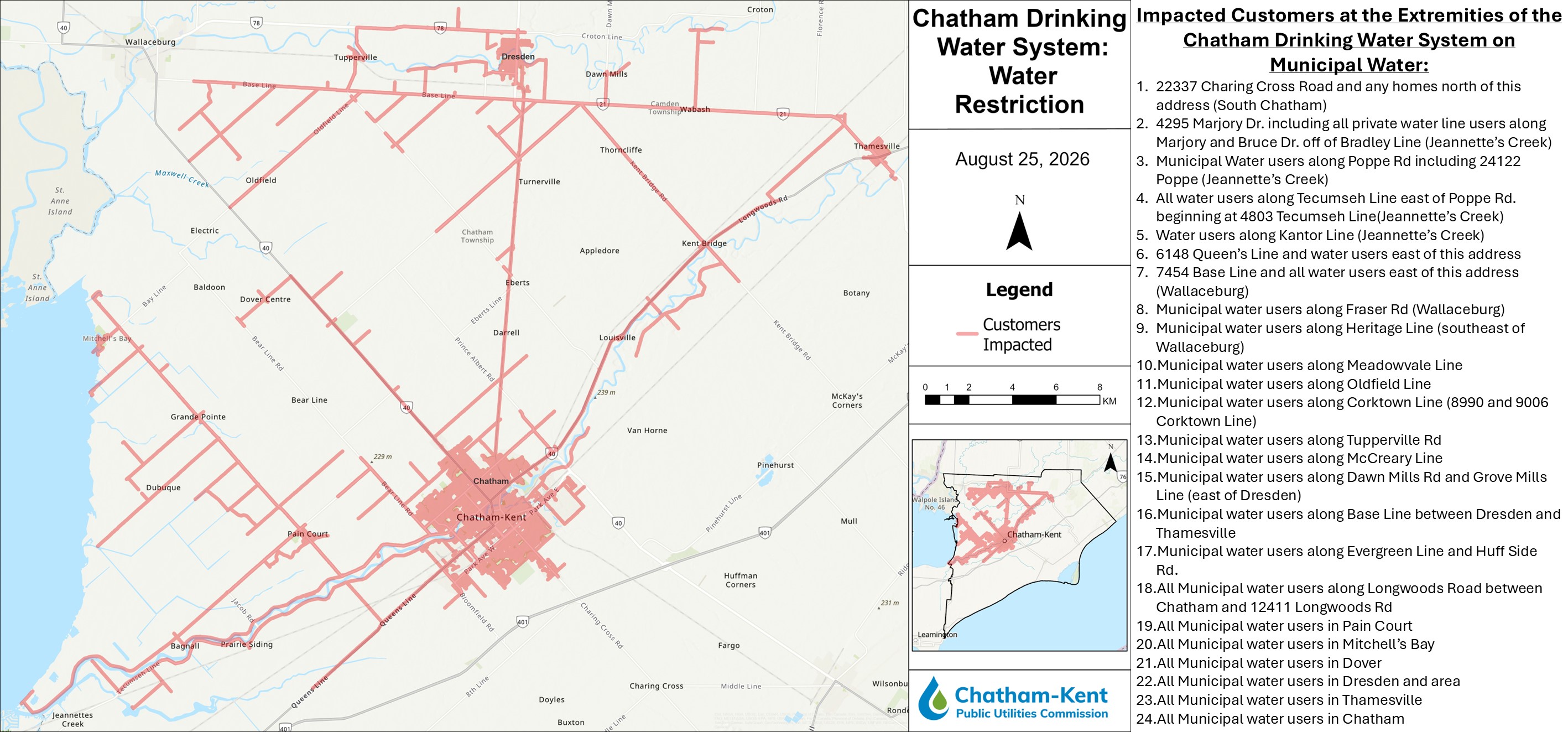
Emergency Severe Water
Restrictions in Effect for Chatham and Surrounding Communities -
August 29
This is an important message from CKAlert. The
Municipality of Chatham-Kent is directing residents and
businesses in Chatham and several surrounding communities to
immediately restrict water use to essential purposes only.
There is currently no impact to the safety or quality of the
drinking water. Water from the system remains safe to drink.
These emergency restrictions are temporary and necessary to
maintain adequate supplies while the system stabilizes
following the repairs.
The emergency severe water restrictions apply to:
• Chatham
• Grande Pointe
• Pain Court
• Dover Centre
• Mitchell’s Bay
• Dresden
• Tupperville
• Eberts
• Jeannette’s Creek
• Thamesville
• Kent Bridge
Residents must immediately restrict water use. Until further
notice, residents in the affected communities are directed
to use municipal water only for essential purposes,
including drinking, brushing teeth and flushing toilets.
Residents are directed to stop other water use, including:
• Showering and bathing
• Doing laundry
• Watering lawns and gardens
• Washing vehicles
• Filling pools or hot tubs
• Other non-essential uses of water
The Municipality is also shutting down municipal operations
that require significant water use in the impacted
communities, including splash pads, arenas and municipal
pools.
Carney SIGNS A
70 Billion Dollar Mine Trump Cannot Ignore - Aug 1, 2026
Canada just approved a mine the United States cannot replicate
on its own soil — and the number everyone missed isn't the $70
billion.
Statement
by Prime Minister Carney on Emancipation Day
August 1, 2026
Ottawa, Ontario
“Today,
communities across Canada mark Emancipation Day. On this day in
1834, the Slavery Abolition Act came into effect across
the British Empire.
Slavery existed
here – in New France, in the Maritimes, in the households of the
powerful. While the Act marked a turning point, freedom was not
granted in a single day. It was taken, held, and defended – by
those who fled, by those who were freed and stayed to build, and
by generations who came after.
When slavery
ended, segregation endured. Africville was razed. Black
Canadians were refused service, denied housing, and separated in
schools and churches. Yet, despite these barriers, they built
lives for themselves and opened doors so many more could follow.
Black Canadians
have gone on to serve as mayors, members of Parliament,
senators, Cabinet ministers, and as Governor General. Those
doors were not opened by accident, but by people who were
determined that this country should live up to what it claimed
to be – a country founded on the fundamental insight that unity
does not require uniformity.
Today, we
honour those whose courage helped make our country freer,
fairer, and stronger – and we recommit ourselves to building a
Canada where everyone has the opportunity to thrive.”
BC Wildfire
Crisis Deepens | Big Bar Complex Nears 160,000 Hectares &
Thousands Evacuated - 112,558 views - Aug 3, 2026
British Columbia's wildfire crisis continues to intensify. The
massive Big Bar Complex is nearing 160,000 hectares, making it
one of the largest active wildfire complexes in Canada. With 131
active wildfires, 57 out of control, thousands of residents
evacuated, and extreme heat returning this week, firefighters
face increasingly dangerous conditions. Watch this update for
the latest wildfire developments, evacuation orders, road
closures, and the forecast for British Columbia.
Legendary
former CTV News chief anchor Lloyd Robertson dies at 92 - Aug 4,
2026
Former CTV
National News chief anchor Lloyd Robertson has died. Genevieve
Beauchemin reports on his extraordinary career in journalism and
his enduring legacy.
Carney SIGNS
2.3 Billion Dollar Arctic Deal That CUTS Musk Out Of Canada's
Defence Network
Canada just cut Elon Musk out of its Arctic defence network —
with a $2.3 BILLION satellite deal that changes everything.
For 18 years this file sat untouched. Then in eight months,
Ottawa turned it into the largest contract in Telesat's history
— and said no to both Starlink and a French-backed alternative.
Here's the real story behind the number nobody's talking about:
69.
MeidasTouch
host Ben Meiselas reports on Canada’s Prime Minister Mark Carney
sticking it to Trump and Trump’s top ally Gianni Infantino and
Meiselas also highlights the incredible efforts of Meidas Canada
leader Charlie Angus who has working to throw out US Ambassador
to Canada Pete Hoekstra from the country. Aug 5, 2026
Moscow's
Kaliningrad Land Bridge Is Gone—Millions Panic as Ukraine SHUTS
DOWN ALL Russia Bridges - Aug 5, 2026
The hybrid warfare tactics launched by Russia—including migrant
surges, balloons, and underground tunnels—aimed at easing
pressure on its Kaliningrad exclave and destabilizing Europe
have backfired, effectively placing its own stronghold under
siege.
Latvia, Lithuania, and Poland have thwarted Russia’s plans by
closing their land borders and strengthening their
fortifications. At the same time, Ukraine’s attacks on ports and
refineries in St. Petersburg have largely paralyzed the sea
route—Kaliningrad’s sole lifeline.
This situation has led to a severe fuel crisis in
Kaliningrad—extending to the implementation of digital ration
cards—and has constrained the military capabilities of the
Russian Baltic Fleet. Once a strategic outpost that threatened
NATO, Kaliningrad has today become a besieged “soft underbelly,”
with its fate now in the hands of its neighbors and vulnerable
maritime routes.
Building
affordable homes in Toronto - Aug 5
Government
of Canada and City of Toronto to build thousands of new
rental homes
August 5, 2026
Toronto, Ontario
In a rapidly
changing world, a confident Canada is choosing to build.
Canada’s new government is building major projects – new ports,
mines, highways, and energy corridors – that will unlock
billions of dollars in new investment and connect Canadian
businesses to new export markets around the world. In parallel,
we are building strong communities, starting with homes
Canadians can afford.
In Toronto,
thousands of new homes have already been planned, permitted, and
approved, but lack the financing to begin construction. Today,
the Prime Minister, Mark Carney, joined the Mayor of Toronto,
Olivia Chow, to announce a new partnership to unlock these
projects and start building.
Over the next
three years, Canada’s new government, in partnership
with the City of Toronto, will invest over $2.7 billion to build
more than 18 housing projects across Toronto. These
projects will deliver more than 5,600 new rental homes,
with shovels in the ground on more than 4,500 homes before the
end of this year.
Every home in
this portfolio is a rental. The portfolio includes affordable,
supportive, rent-geared-to-income, and rent-controlled
housing. A healthy housing system needs the full range, and this
partnership builds it through two complementary channels.
Non-market – through Build Canada Homes. Non-market
housing is owned and operated by non-profit organisations,
housing cooperatives, or government and public agencies, with
the primary objective of ensuring affordability. Through Build
Canada Homes, we will provide more than $310 million
to advance nine housing projects on City-owned land. This
investment will deliver nearly 1,900 rental homes – with more
than 700 supportive and affordable – as well as more than 1,100
rent-controlled homes delivered by the non-market housing
sector. To further unlock these projects, the City of Toronto
will contribute public land at nominal value and more
than $530 million in capital funding and financial
incentives, including up to 99-year exemptions from municipal
and school property taxes.
Market
– through the Canada Mortgage and Housing Corporation’s (CMHC)
Apartment Construction Loan Program. Market housing is
built by private developers and rented at market rates. It is
the largest source of new supply, adding homes at scale to ease
pressure across the whole system.Through
CMHC’s Apartment
Construction Loan Program, we will provide over
$1.8 billion in low-cost financing for nine housing
projects. This investment will deliver over 3,700 rental homes,
with more than 1,000 of them affordable. We will also allocate
up to $600 million in financing through the
program so that more Toronto projects can move forward as they
become ready.
The entire
portfolio also reflects how we’re building:
Inclusively: The partnership will support a
100-unit, Indigenous-led supportive housing development at
15 Denison Avenue.
Sustainably: Two projects lead the way in
showcasing Build Canada Homes’ modern methods of
construction, with a mass-timber, low-carbon build at
1113-1125 Dundas Street West and a volumetric-modular
development at 805 Wellington. These methods build faster,
cut waste, and reduce emissions by up to 22%, helping
deliver sustainable, affordable housing at scale.
In
solidarity with workers: The portfolio is expected
to support roughly 2,100 jobs a year over its construction
period.
Canadian: Projects will prioritise Canadian
materials – including Canadian steel and lumber – under the
government’s Buy
Canadian Policy.
This
partnership with Toronto builds on the federal government’s work
over the past year to supercharge housing construction across
the country. In September, we launched Build
Canada Homes to build housing at scale and speed. Since its
launch, Build Canada Homes has already committed to nearly
17,000 units through 17 partnerships, with more than 1,900 homes
already under construction. We have eliminated the GST on homes
up to $1 million for first-time homebuyers – saving Canadians up
to $50,000 on the purchase of their first home. In Ontario, we
are eliminating the full 13% of the HST for new homes, saving
buyers up to $130,000 on the purchase of their home. In Toronto,
those savings go even further. Through the Canada-Ontario
Partnership to Build, we provided the City of Toronto with
$1.5 billion to cut residential development charges by 40 to 60%
– reducing the cost of a new single or semi-detached home by
roughly $83,000.
In the face of
global uncertainty, Canada’s new government is building across
the country to deliver the strong, safe, and affordable homes
Canadians need to live the lives they want for themselves. We
are working in the spirit of cooperative federalism – in full
partnership with provinces, territories, and municipalities – to
build a stronger, fairer, and more prosperous Canada for all.
Quotes
“Toronto is becoming a model
for how a great city can build its way forward. Together
with the City of Toronto, we are getting thousands of new
rental homes built, across every part of the housing system,
in strong, safe communities that people can afford. This is
what is possible when governments build together.”
— The Rt. Hon. Mark Carney,
Prime Minister of Canada
“Today’s announcement shows
what’s possible when governments work together. I want to
thank Prime Minister Mark Carney, Minister Gregor Robertson,
and our federal partners for their commitment to building
more homes in Toronto. Today’s investment means more people
will have the opportunity to find a home they can afford,
stay close to their communities, and build a future in the
city they love. Together, we are delivering the housing
Toronto needs and creating a more affordable, caring city
for everyone.”
— Her Worship Olivia Chow,
Mayor of Toronto
“Every Canadian deserves a
safe, affordable place to call home. Through our partnership
with the City of Toronto, we are aligning investments and
working together to accelerate the construction of
much-needed housing. By reducing barriers and speeding up
delivery, we are helping build more homes and creating
stronger, more affordable communities across the country.”
— The Hon. Gregor Robertson,
Minister of Housing and Infrastructure and Minister
responsible for Pacific Economic Development Canada
Russia’s July
Losses Are CATASTROPHIC… Putin STILL Calls It “According to
Plan” - Aug 6
July 2026 proved to be Russia’s deadliest month of the war so
far, with a staggering 42,860 casualties. Despite these massive
human losses, Russian forces managed to fully claim just 37.85
square kilometers of Ukrainian territory. As commanders feed
false reports to an isolated and delusional Vladimir Putin,
Ukraine’s lethal attrition strategy continues to grind down the
Russian military toward a breaking point.
Ontario
Wildfire UPDATE
Ontario's 2026 wildfire season is the worst on record — but for
the first time, there are real signs of progress. As of August
5th, the number of out-of-control fires in Northwestern Ontario
has dropped 75% from the July peak. But a new threat arrives
today: a severe thunderstorm system with wind gusts up to 90
km/h and lightning moving directly over the fire zones.
In this update (August 6, 2026), we break down everything you
need to know:
This El Nino Took A Shocking Turn!
Stronger Than 1877? - Aug 5
Could we be witnessing one of the strongest El Niño events ever
observed? In this 43-minute in-depth analysis, we take a
comprehensive look at the latest oceanic and atmospheric data to
determine whether this rapidly evolving El Niño could rival—or
even surpass—historic events such as 1877, 1982-83, 1997-98, and
2015-16.
We'll break down the newest sea surface temperature anomalies,
subsurface heat content, trade wind behavior, Southern
Oscillation Index (SOI), Multivariate ENSO Index (MEI), and
long-range model guidance from around the world. We'll also
discuss what this could mean for the upcoming winter across
North America and how a potentially historic El Niño could
reshape global weather patterns.
BC Wildfire
Crisis Deepens | 103 Fires, 8,000 Evacuated & High-Risk Saturday
- Aug 7
British Columbia's wildfire emergency is intensifying as 103
active wildfires burn across the province, with 49 fires
completely out of control and more than 324,000 hectares already
scorched this season. Thousands remain under evacuation orders
as a dangerous dry lightning event threatens to ignite new fires
on Saturday. Get the latest BC wildfire update, evacuation
information, fire weather forecast, and the regions facing the
highest wildfire risk.
B.C. Wildfires
Turn Deadly | Bald Range Fire Hits 13,618 Hectares — 1 Dead &
21,000+ Evacuated - Aug 10
B.C. wildfires have turned deadly as the Bald Range Fire near
Summerland reaches 13,618 hectares, while more than 21,000
people have been displaced and one wildfire-related death has
been confirmed. This latest British Columbia wildfire update
covers evacuations, fire conditions, major active fires, road
closures, and the growing wildfire threat across B.C.
Minister MacKinnon announces measures to
strengthen interprovincial trade of Canadian steel - Aug 10
Minister of Transport and Leader of the Government in the House of Commons,
Steven MacKinnon makes announcement regarding new measures for the
interprovincial transportation of Canadian steel and the strengthening of
domestic supply chains.
B.C. officials give update on the Bald Range fire
- Aug 10
Officials give an update on the efforts to fight the Bald Range fire and protect
structures in the community.
Ontario ministers provide update as northern
Ontario wildfires burn - Aug 11
Ontario's Natural Resources Minister Mike Harris is expected to take questions
alongside the province's ministers of emergency preparedness and Indigenous
affairs on Tuesday as crews try to contain wildfires burning in the province's
northwest.
AMAZING NEWS!
'Follow the Money All the Way to Mark Carney's Canada - Aug 11
Let’s talk about some amazing economic news for Canada, why JD
Vance has been attacking Canadian Prime Minister Mark Carney in
the press this week and how global financial experts are yelling
from the rooftops that Canada is winning Trump’s trade war.
AUSTRALIA BACKS
CANADA — "Good On Canada For Avoiding Our Mistakes" - Aug 13,
2026
Canberra chose AUKUS nuclear submarines for $368 BILLION. Ottawa
chose German conventional boats from a working production line.
Now Australian experts are saying the quiet part out loud: it's
not about propulsion, it's about control.
Canadian dollar
'pushing higher' due to pullback in U.S. dollar - Aug 13
Karl Schamotta, chief market strategist at Corpay, joins BNN
Bloomberg to discuss discuss the U.S. economy and assess the
U.S. Fed's rate path.
Taking Stock:
Canada’s evolving trade relationship with China - Aug 14, 2026
Amanda Lang takes a ‘by the numbers’ look at Canada's trade
relationship with China, then talks it over with Nick Leung,
director of the McKinsey Global Institute and author of the new
book 'The Next China is still China'. Amanda then looks at
whether supply management should be up for negotiation in
Canada-U.S. trade talks, with Sylvain Charlesbois, director of
the Agrifood Analytics Lab at Dalhousie University.
Trump's Trade
Plan BACKFIRES As Detroit Warns Of Billions In New Costs - Aug
14
Detroit's own automakers just handed Canada its strongest trade
card — and they didn't even mean to.
Ford, GM, and Stellantis have been quietly running the numbers
on Washington's new content rules for the revised North American
trade deal. The result? A minimum of $2 BILLION in extra annual
costs — per company. And buried in the reporting is one sentence
from an American executive that says more about Canada's
leverage than any government statement this year.
BBC Interview
Where Carney RIPPED Trump Apart on HIS LIES - Aug 14
Before becoming Prime Minister, Mark Carney sat down for a
widely watched interview and delivered one of the clearest early
rebukes of Donald Trump’s tariff threats against Canada. In the
conversation, Carney called the action bullying, rejected the
fentanyl and immigration national-security justifications as
baseless, and stated that Canada would not cave or back down. He
described the move as a violation of the trade agreement the
United States itself had negotiated and warned that the economic
consequences would rebound negatively on American growth,
inflation, and reputation.
Carney also outlined a measured but firm approach to retaliation
— matching tariffs while targeting areas of maximum impact on
the United States and minimum self-harm to Canada — and
emphasized that Canadians were in no mood for concessions. This
video revisits the key moments from the interview that first
signaled how Carney would handle pressure from Washington.
Mark Carney
Trump interview, Carney calls Trump bully, pre-PM Carney
tariffs, Carney tariff response, Trump 25 percent tariffs
Canada, Carney retaliation promise, fentanyl tariff
justification, trade agreement violation, Carney energy deficit
explanation, Canada will not cave, Carney defiant interview,
Trump tariffs rebound US, targeted Canadian retaliation, Carney
leadership style, viral Carney interview, early Carney Trump
confrontation, Canada US trade dispute, Carney national security
claim, pre-prime minister Carney, Carney stand up to bully
Mark Carney Trump interview from before he became prime minister
shows Carney calling Trump a bully, rejecting the fentanyl
tariff justification, promising targeted retaliation, and
declaring Canada will not cave while warning the tariffs will
rebound on the US economy.
Statement
by Prime Minister Carney on National Acadian Day
August 15, 2026
Ottawa, Ontario
“Today, on National Acadian Day, we celebrate the identity and
resilience of the Acadian people.
Acadians are
one of the oldest Francophone communities in North America,
settling in what is now Atlantic Canada over four centuries ago.
Their story is one of hardship met with perseverance. Beginning
in 1755, British colonial authorities drove them from their
land, and in the generations since, they rebuilt their
communities while protecting and celebrating their language,
culture, and traditions. That resilience has helped shape the
identity of Canada itself.
The Government
of Canada is a strong partner to Acadian communities in their
mission to protect their heritage and promote the French
language. Starting this year, we are investing $5 million over
five years to support National
Acadian Day celebrations. Through the Atlantic
Canada Opportunities Agency, we are helping Acadian and
Francophone businesses grow and break into new markets. We are
also raising Francophone immigration targets outside Québec so
that Acadian employers can find the French-speaking talent they
need to grow their businesses.
As part of our
bid to host the Sommet de la Francophonie in 2028 in
the National Capital Region, we look forward to the opportunity
of welcoming delegations from across the French-speaking world
and showcasing the vitality of the French language in Acadie and
across the country.
Building Canada
strong means celebrating the languages and traditions of all
Canadians. For more than 400 years, Acadians have shown us that
a proudly embraced identity is a source of strength for the
entire country.
Happy National
Acadian Day!”
Manitoba
premier discusses U.S. trade, councillor charges, economic
pitches for Churchill - Aug 13, 2026
Premier Wab Kinew talks about using U.S. liquor sales bans as
trade leverage, the legislative challenges surrounding municipal
councillors facing criminal charges, and pitching resource
projects to international investors.
Exactly how
Ukraine’s targeted attacks are shattering Russia - Aug 17
UKRAINE’S daring and destructive drone attacks shattering
Vladimir Putin’s Amazon-style empire have thrown the Kremlin’s
economy into freefall. A dozen Wildberries warehouses have been
blitzed in the past month with Kyiv now plotting for their next
death blow against Moscow to further paralyse Putin’s faltering
war machine.
Ottawa Facing
Calls to Invest in National Waterbomber Fleet - Aug 13, 2026
With over 600 active wildfires burning across the country, the
pressure is mounting on Ottawa to invest in a national
waterbomber fleet. A recent study by De Havilland Canada shows
that nearly 90% of Canadians support a centralized fleet to help
provinces respond to these devastating fires. As provinces
increasingly request additional aid, what would a national fleet
actually look like, and could it be the key to managing future
wildfire seasons? In this interview, John Gradek, Aviation
Management Expert at McGill University, breaks down the
logistics, the costs, and the critical need for a unified aerial
response to Canada's wildfire crisis.
Prime
Minister Carney announces the largest clean energy
investment in North American history
August 17, 2026
St. John’s, Newfoundland
In a more
dangerous and divided world, Canada’s new government is focused
on what we can control: building a stronger, more independent,
and more sustainable country.
Canada is
starting from a position of strength. We have what the world
wants. We have the natural resources, critical minerals, and
clean power that will build this century. We have the workers
and the ingenuity to turn that potential into strength. We
understand we can build faster and bigger when we work together.
And we have trust, the most valuable commodity in an
increasingly volatile, unreliable world.
We have
everything we need to build the future we want.
Today, the
Prime Minister, Mark Carney, alongside the Premier of Québec,
Christine Fréchette, the Premier of Newfoundland and Labrador,
Tony Wakeham, and the CEOs of Hydro-Québec and Newfoundland and
Labrador Hydro,announced a historic
agreement to upgrade and expand the Churchill Falls Generating
Station and develop the Gull Island project and related
transmission, building one of the largest electricity projects
in North America.
As part of this
agreement, the federal government will provide$10 billion in federal financing to:
Upgrade and
expand the Churchill Falls Generating Station.
Develop the
massive Gull Island hydroelectricity project.
Unlock
co-investment opportunities with the Innu of Labrador in a
major new Labrador onshore wind project.
Build
associated transmission lines.
Together, these
projects represent the largest clean energy investment
in North American history, at nearly $70 billion. They will
generate 14,000 megawatts of clean, renewable power – nearly
tripling the current generating capacity of Churchill Falls. That
is enough power to light, heat, and cool all the homes in
Toronto, Montréal, and Vancouver combined. These projects will
support 23,000 jobs – from the skilled trades to engineering –
and contribute $31 billion to Canada’s GDP through the early
2040s.
The Labrador
Trough is a world-class mining region across Newfoundland and
Labrador and Québec, with significant sources of high-purity
iron ore. To harness this strategic asset and create high-paying
careers for Canadian workers, the government announced the
referral of the Labrador Trough Clean Power, Critical
Minerals and Infrastructure Corridor to the Major Projects
Office (MPO). The MPO will coordinate and structure
federal financing, accelerate permitting requirements, and work
with Indigenous Peoples to forge meaningful partnerships.
In addition,
Canada’s new government will support strategic,
pre-development projects in the Labrador region, funded
under the First and Last Mile Fund (FLMF) through Natural
Resources Canada. This includes the following projects:
Labrador
West Transmission Expansion to assess the transmission
infrastructure needed to connect critical minerals mining
operations in western Labrador to the electricity grid,
supporting regional opportunities and mine electrification.
Kami Iron
Mine Partnership’s project to undertake planning and
feasibility work for the transportation and energy
infrastructure required for the large-scale Kami iron ore
project near Wabush, Newfoundland and Labrador.
Focus
Graphite’s project to undertake pre-construction work for a
new transmission line and road connecting the Lac Knife
graphite project to Hydro-Québec’s power grid, advancing the
development of projects that will support the battery and
energy storage technologies this country and our allies
need.
SFP Pointe-Noire’s
project to expand critical minerals handling capacity and
related rail infrastructure, strengthening a key
transportation gateway for mining production in the Labrador
Trough.
We are making
Canada the best place in the world to build and invest in clean
energy. By combining the Clean Economy Investment Tax Credits,
efficient project approvals, cooperation agreements with
provinces and territories, strategic investments, and attractive
financing, we are giving builders the certainty to build big and
move fast.
Today’s
agreement realises the enormous potential of Canada when we
build together.
This is
cooperative federalism at work.
In a more
dangerous and volatile world, we’re choosing to build clean,
affordable, and reliable energy systems, in partnership with all
Canadians, for all Canadians.
Quotes
“Canada is extending its
unique advantage in clean, reliable, and affordable power.
Because when we master energy, we master our destiny.
Through cooperative federalism, we are unlocking our immense
potential, building big, building sustainably, building in
partnership, and building Canada strong for all.”
— The Rt. Hon. Mark Carney,
Prime Minister of Canada
“In the current geopolitical
context, it is vital for every nation to secure its energy
future. I am very proud to announce today the conclusion of
this new agreement, which is a priority for Québec,
particularly for generations to come. Through this
partnership, we are supporting the energy transition and
enabling the growth of our economy through renewable energy,
while ensuring our energy independence.”
— Christine Fréchette, Premier
of Québec
“This is a win-win-win for
Newfoundland and Labrador, the federal government, and
Québec. I want to thank Prime Minister Carney and Premier
Fréchette for their leadership throughout this process. We
are finally replacing the notorious 1969 Churchill Falls
deal and the 2024 MOU with a new deal that will guarantee us
more power, more value, and more transmission.
Newfoundlanders and Labradorians will finally be the primary
beneficiary of our own resources, with complete control over
whether we use our power to develop our economy or sell to
outside markets. Today is not about what we can tear up,
it’s about what we can build up. It is now time for us to
roll up our sleeves and get to work to build a better and
brighter future for all of us.”
— The Hon. Tony Wakeham,
Premier of Newfoundland and Labrador
Quick facts
Today’s
agreement is the largest clean energy investment in North
American history, nearly tripling the current generating
capacity of Churchill Falls. Together, these projects will
deliver 14,000 megawatts of clean, renewable power,
support 23,000 jobs in the construction phase alone, and
contribute $31 billion to Canada’s GDP through the early
2040s.
The
agreement advances:
Canada’s National Electricity Strategy, which aims
to double the capacity of our grid by 2050 and supply
clean, reliable, affordable power across the country for
decades to come.
The
Atlantic Energy Strategy, which wasreferred
to the Major Projects Office in the fall of 2025. The
Strategy focuses on developing renewable and
non-emitting energy across Atlantic Canada – onshore and
offshore wind, nuclear, and hydro – to meet rapidly
growing demand across Eastern and Atlantic Canada and
beyond.
Today’s
investments strengthen the interprovincial grid and the
export infrastructure that carry clean, affordable power and
Canadian resources to markets at home and abroad.
The
Labrador Trough is a world-class mining region stretching
across Labrador and Québec. With significant sources of
high-purity iron ore, it is a strategic asset for
decarbonising global steel supply chains, reinforcing
Canada’s leadership in both renewable energy and critical
minerals, and giving Canada a significant competitive
advantage in the transition to a cleaner economy.
Strategic, pre-development projects in the Labrador
region will be supported through the
First and Last Mile Fund (FLMF). The FLMF is backed
by $1.5 billion in federal funding announced in
Budget 2025. It supports infrastructure that unlocks new
mines and moves Canada’s resources to customers at home
and abroad. Recognising that most critical minerals
deposits and enabling infrastructure projects in Canada
are located on Indigenous territories, the FLMF makes
specific funding available to enable Indigenous
leadership, engagement, and participation throughout the
mining value chain.
On clean
energy, Canada already leads from a position of strength:
the lowest residential electricity costs in the G7, the
second-lowest industrial electricity costs in the G7 and the
OECD, and the second-highest share of clean electricity
generation in the G7. Today, approximately 80% of Canada’s
electricity generation is non-emitting.
To build on
that advantage, Canada’s new government is advancing
strategic investments in the modernisation and expansion of
the country’s electricity infrastructure, including:
Major Clean Economy Investment Tax Credits for clean
electricity, clean technology, and carbon capture,
utilisation, and storage.
Strategic financing through the Canada Infrastructure
Bank (with a $20-billion clean energy target), the
Canada Growth Fund, and the Indigenous Loan Guarantee
Program (envelope doubled from $5 billion to
$10 billion).
A new
Productivity Super-Deduction, enhanced tax incentives
covering all new capital investment, which allows
businesses to write off a larger share of the cost of
these investments right away.
Carney joins
Quebec, Newfoundland and Labrador premiers to announce clean
energy initiative - Aug 17
Prime Minister Mark Carney joined Quebec Premier Christine
Frechette and Newfoundland and Labrador Premier Tony Wakeham in
St. John’s, N.L. Monday, to announce a non-binding deal on the
Churchill Falls project.
The deal comes after years of negotiations and an independent
review, with Hydro-Quebec and Newfoundland and Labrador Hydro
jointly owning the Churchill Falls generating station, under a
contract signed in 1969.
The provinces had reached a framework agreement in 2024 to end
that deal and create a new energy-sharing arrangement with
expanded generating capacity. But after Wakeham was elected last
fall, he ordered a review of the deal, restarting negotiations.
“We are finally turning the page on one of the darkest chapters
in our past and replacing both the notorious August 1969
Churchill Falls Agreement and the 2024 MOU, with a better deal
for all of us,” said Wakeham.
Under the new agreement, Quebec would have a guaranteed supply
of electricity from Churchill Falls until 2077. The agreement
effectively terminates and replaces the original 1969 deal.
“Canada has built big before, the ambitions of James Bay and the
original Churchill Falls,” Carney said. “Today, we’re coming
together, determined to build up that greatness, to develop the
biggest clean energy initiative in North American history.”
Statement
by Prime Minister Carney on ongoing Canada-U.S. trade
negotiations
August 18, 2026
Ottawa, Ontario
“Over the last
number of weeks, Canada has engaged in intensive discussions
with the United States to address outstanding trade issues and
deliver greater certainty and real benefits for Canadian
businesses, workers, farmers, and families.
Substantial
progress has been made, although there is important work still
to be done. As this work is ongoing, the United States has
agreed to postpone the implementation of its 50% tariff on a
range of Canadian goods under Section 338 of the U.S. Tariff Act
of 1930 until end of day, August 21.
While we
continue this work, Canada remains focused on building a
stronger, more independent, and more competitive economy at
home.”
Ukraine Pounds
Russia, Prompting Angry Putin To Threaten U.K. - Aug 20
Ukraine launched one of its largest-scale long-range drone
offensives of the war, targeting Moscow and multiple other
regions with over 800 drones. Now, Russia is threatening the UK
with "consequences," warning that London will pay a heavy price
for allegedly allowing British-made drones to strike targets
deep inside Russian territory. David Shuster breaks it down on
Rebel HQ.
Manitoba
Premier Wab Kinew comments on U.S. alcohol ban – August 20, 2026
Manitoba Premier Wab Kinew holds a news conference in Winnipeg
to urge Canadians not to purchase U.S. alcohol, even if a new
Canada-U.S. trade agreement requires American alcohol to be made
available again at liquor stores across Canada.
Buy Canadian
Group launches Shoppa.ca - Aug 20
Lee Smith, chief Canadian officer at Buy Canadian Group Inc.,
joins BNN Bloomberg to discuss the launch of their online retail
website hosting Canadian-owned businesses.
Statement
by Prime Minister Carney on Canada-U.S. trade negotiations
August 21, 2026
Ottawa, Ontario
“Over the past
18 months, Canada’s new government has focused on building our
strength at home, diversifying our partnerships abroad, and
striking a fair deal with the United States.
Our objectives
in our trade negotiations have been to:
Preserve
tariff-free access to the U.S. for the vast majority of
Canadian business;
Provide
greater stability to our trade relationship;
Significantly reduce U.S. tariffs on our key strategic
industries, so that Canadian businesses in these sectors
would have the best access of any in the world;
Protect our
small and medium-sized businesses – the lifeblood of our
economy – including by removing the imminent threat of new
tariffs; and
Maintain
our flexibility, independence, and sovereignty so we can
keep building the Canada we want.
We have
recognised from the beginning that America has changed, and that
we will not return to our old relationship. Our government
understood, before many, that America is altering all its trade
relationships. Putting tariffs on its closest allies and
charging for access to its vast market.
We have worked
in that context. To strike a fair deal that would provide the
best access to the U.S. market and greater certainty to Canadian
businesses and workers. Throughout, our goal has been to secure
the best deal for Canadians, never a deal at any price or on any
deadline.
In recent
weeks, we made important progress toward improving Canada’s
position as having the best deal in the world with the U.S.
However, that
progress has not been enough to meet our objectives for
Canadians. As a result, this evening, I have decided to suspend
trade negotiations with the U.S. and have directed Canada’s
negotiators to return to Ottawa. They have worked hard, in good
faith, to defend the interests of Canadians throughout these
negotiations up until the very last minute. However, last-minute
changes in the U.S. proposed terms were unfair, uneconomic, and
called into question the reliability of any deal.
At midnight
tonight, the U.S. intends to impose a 50% tariff on roughly
$28 billion of Canadian goods. Canada will match those
tariffs dollar for dollar to protect our workers and businesses.
In the coming
days, the government will introduce additional measures to
support Canadian workers and businesses, building on the nearly
$25 billion in support provided over the past 18 months.
These actions
complement Canada’s core economic strategy. From day one, we
have been focused on building our strength at home and
diversifying our partnerships abroad.
That strategy
is working. We are advancing nearly $500 billion in major
infrastructure projects. In parallel, we are unlocking new
export markets for Canadian businesses. Our existing free trade
deals already provide Canada with preferential access to
1.5 billion consumers, and we are on track to double that market
access by the end of this year.
Canadian
economic growth is accelerating, and we are on course to have
the second-fastest growth in the G7 over the next two years. Our
economy is creating jobs at four times the rate of the United
States. Our exports to non-U.S. markets are on track to double
over the next decade. Foreign direct investment in Canada is at
its highest level in two decades, running at twice the rate of
our nearest G7 competitor. Canada now ranks as the most
attractive country in the world for infrastructure investment.
Canada has what
the world wants. And we will not allow any nation to determine
our future. We will set our own course to keep building Canada
strong for all.”
US-CANADA Deal
BLOWS UP at MIDNIGHT!! - Aug 22, 2026
MeidasTouch host Ben Meiselas reports on Canada's Prime Minister
Carney walking away from trade talks with Trump and the United
States and instructing Canadian negotiators to return to Canada
after Trump tried to bully Canada in a last minute bad faith
shakedown and Carney refused to be bullied.
Mark Carney
just said SHUT UP to Trump's STUPID Deal - Aug 22, 2026
Minister Mark Carney has suspended all trade negotiations with
the United States and ordered Canadian negotiators to return to
Ottawa. In an official statement, Carney said last-minute
changes in the U.S. proposed terms were unfair, uneconomic, and
called into question the reliability of any deal. Canada will
match the new 50% tariffs on roughly $28 billion of Canadian
exports dollar for dollar.
The American side claimed Canada walked away from a strong offer
and introduced new demands. Carney’s account and reporting from
both capitals point to U.S. last-minute shifts as the breaking
point. Premiers including Doug Ford have publicly backed a
strong tariff-for-tariff response. This video breaks down the
collapse of the talks, the official statements, the economic
stakes, and Canada’s parallel strategy of building strength at
home and diversifying trade.
Mark Carney suspends trade talks, Canada US trade negotiations
collapse, 50 percent tariffs Canada, dollar for dollar counter
tariffs, no deal better than bad deal, last minute US demands,
Carney official statement, Trump tariff pressure, Canadian
negotiators recalled, Jamison Greer statement, Doug Ford tariff
support, BC premier politeness not weakness, tariffs tax on
Americans, trade war uncertainty, Canada infrastructure 500
billion, Canadian job creation vs US, diversify trade
partnerships, Carney sovereignty stance, US Canada trade
breakdown, retaliatory tariffs Canada
Mark Carney suspends trade talks with the United States after
last-minute US demands, announces Canada will match 50 percent
tariffs dollar for dollar, states no deal is better than a bad
deal, and points to unfair changes that called the reliability
of any agreement into question while advancing Canada’s domestic
strength and diversification strategy.
PM Mark Carney
speaks to media after suspension of Canada-U.S. trade talks –
August 22, 2026
Prime Minister Mark Carney holds a news conference on Parliament
Hill in Ottawa after Canada and the United States failed to
reach a trade agreement before a late Friday deadline and Canada
said it was suspending negotiations. The prime minister has
indicated that his government intends to retaliate
dollar-for-dollar against new U.S. tariffs on Canadian goods.
"Canada Just
Did What No Country Has Done To Trump!" | Bill Clinton - Aug 22
Trump 50% tariffs on Canada, Carney retaliatory tariffs
September 8, US-Canada trade war 2026 — Bill Clinton breaks down
what just happened between the United States and Canada after
trade talks collapsed and 50% tariffs went into effect on $20
billion in Canadian goods. Canada has vowed to match those
tariffs dollar for dollar. In this video, Clinton explains how
Trump invoked Section 338 of the 1930 Smoot-Hawley Tariff Act —
a law no president has ever used before — and why Canada's
response could trigger an escalation cycle neither side can
control. What does this mean for American families, prices, and
the midterm elections? Clinton walks through the facts, the
failures, and what comes next.
B.C. Premier
David Eby comments on suspension of Canada–U.S. trade talks –
August 22, 2026
Speaking with reporters in Vancouver, Premier David Eby comments
on Canada’s decision to suspend trade negotiations with the
United States hours ahead of a deadline to reach a deal. The
United States is now set to impose a new round of tariffs on
imports from Canada, with Prime Minister Mark Carney vowing to
implement dollar-for-dollar tariffs on American goods in
retaliation.
Ontario Premier
Doug Ford comments on suspension of Canada–U.S. trade talks –
August 22, 2026
Speaking with reporters in Toronto, Doug Ford, the premier of
Ontario, comments on Canada’s decision to suspend trade
negotiations with the United States hours ahead of a deadline to
reach a deal. The United States is now set to impose a new round
of tariffs on imports from Canada, with Prime Minister Mark
Carney vowing to implement dollar-for-dollar tariffs on American
goods in retaliation.
Manitoba
Premier Wab Kinew comments on suspension of Canada–U.S. trade
talks – August 22, 2026
Speaking with reporters in Winnipeg, Premier Wab Kinew comments
on Canada’s decision to suspend trade negotiations with the
United States hours ahead of a deadline to reach a deal. The
United States is now set to impose a new round of tariffs on
imports from Canada, with Prime Minister Mark Carney vowing to
implement dollar-for-dollar tariffs on American goods in
retaliation.
Carney
THREATENS Trump, “You Would Want Us to Stop Sending Oil?" - Aug
23
Prime Minister Mark Carney has suspended all trade negotiations
with the United States and ordered Canadian negotiators to
return to Ottawa. In a detailed press conference, Carney stated
that the United States “asked too much and offered too little,”
describing American economic integration as a weapon and noting
that its commitments are sometimes “written in pencil.”
He listed the constantly changing justifications for US tariffs,
dismantled the claim that Canada is running an unfair trade
surplus, and revealed last-minute demands that would have made
Canadian auto production uneconomic and restricted Canada’s
ability to sign other trade deals. Carney confirmed Canada will
match the new tariffs and restated that the country will not
accept a deal at any price.
Statement
by Prime Minister Carney on Ukrainian Independence Day
August 24, 2026
Ottawa, Ontario
“Thirty-five
years ago today, Ukraine’s Parliament proclaimed the country’s
independence. That historic decision marked the beginning of a
new chapter for Ukraine – one defined by freedom, democracy, and
self-determination.
Canada was the
first Western nation to recognise Ukraine’s independence,
deepening a friendship that has grown into an enduring bond
between our nations. That bond is strengthened by the more than
1.4 million Canadians of Ukrainian descent.
As we mark the
anniversary of Ukraine’s independence, Canada reaffirms our
steadfast support for Ukraine’s sovereignty and freedom.
Ukraine’s
future belongs to the Ukrainian people alone. Russia’s illegal
invasion of Ukraine is an attempt to change that fact.
A just and
lasting peace for Ukraine will only come through strength. That
is why Canada joined other nations in imposing one of the
world’s most comprehensive sanctions regimes, targeting more
than 3,500 Russian individuals and entities and over 700
vessels.
While we weaken
Russia, we strengthen Ukraine. This year alone, Canada committed
more than $2 billion in military assistance to Ukraine. We have
extended Operation
UNIFIER to continue strengthening Ukraine’s military and
bolster its long-term defence capabilities. Earlier today,
Canada met with allies and partners in the Coalition of the
Willing to reaffirm our shared commitment to supporting Ukraine
and helping build the conditions for a just and lasting peace.
Today, I join
Ukrainians in Canada and around the world in celebrating
Ukrainian Independence Day. As we did in 1991, Canada stands
unwavering in our commitment to help Ukraine protect its
freedom, restore its territorial integrity, and rebuild a
stronger future.
Slava
Ukraini.”
Prime
Minister Carney announces the largest shipbuilding contract
in Québec’s history
August 24, 2026
Lévis, Québec
In a rapidly
changing world, Canada is setting a new course. We are building
our strength at home, diversifying our trading relationships
abroad, and investing in the infrastructure that will secure our
future. From the ports and corridors that move Canadian goods to
market, to the ships that keep our trade routes open, we are
laying the foundations of a stronger, more self-reliant country.
Established
trading relationships are being tested, and Canada is not
standing still. We are moving fast, seizing new opportunities,
and reducing our dependence on any single partner.
That is why the
Prime Minister, Mark Carney, today announced the largest
shipbuilding contract in Québec’s history. The Government of
Canada will invest more than $11 billion to build six
new program icebreakers for the Canadian Coast Guard in
partnership with Chantier Davie Canada Inc. This
historic investment grows Canada’s domestic shipbuilding
industry, strengthens our ability to keep critical trade routes
open, and reinforces our strategic autonomy.
All six
icebreakers will be built in Canada at the Davie Shipyard in
Lévis, Québec, creating nearly 5,000 good jobs in the
construction phase alone and contributing nearly $650 million
annually to Canada’s GDP. Under the government’s Buy Canadian
Policy, these vessels will be built with Canadian steel and
other domestic materials, while maximising opportunities for
Canadian manufacturers, suppliers, and small and medium-sized
businesses.
The program
icebreakers will replace the Coast Guard’s aging heavy and
medium icebreakers – the ships that work Atlantic Canada and the
St. Lawrence through the depth of winter, and the Arctic through
the summer season. They cut open our most vital sea lanes,
answer the call of ships in distress, and come to the aid of
vessels trapped in the ice.
This investment
will equip the women and men of the Canadian Coast Guard – the
civilian service Canadians count on to keep our waters safe –
with the modern ships they need to answer the call, from search
and rescue to environmental response, for decades to come.
Additionally, it secures Canada’s position as the home of NATO’s
largest icebreaking fleet, bolsters national security in the
North, and protects Canadian interests. Construction will begin
in 2027, this first ship will be ready five years later, and the
full fleet will be in service by 2038.
Canada’s new
government is laser-focused on building a stronger, more
independent, more resilient Canadian economy that drives
prosperity for all. This is our economic strategy at work. We
are expanding the Port of Montréal at Contrecœur and the Port of
Québec to move more Canadian products to global markets. And we
are using major federal procurement, from armoured vehicles to
submarines and icebreakers, to build Canadian industrial
capacity, strengthen domestic supply chains, and create
high-paying careers here at home.
Canada is a
trading nation with the world’s longest coastline. Today, we are
strengthening our capacity to build ships at home, assert our
presence in the Arctic, keep our waterways open, and move
Canadian resources to new markets around the world.
Quotes
“Canada is now the
best-connected economy in the world. Canada is building such
unparalleled market access because we are trusted, reliable,
and have what the world wants. These six state-of-the-art
icebreakers will keep the trade routes that carry Canadian
goods to the world accessible and secure. Built in Lévis by
Canadian workers, they are a lasting investment in a
stronger, more self-reliant Canada.”
— The Rt. Hon. Mark Carney,
Prime Minister of Canada
“Canada’s economic security
and national sovereignty depend on our ability to keep our
waters open, secure, and moving. These six new icebreakers
will keep Canadian trade flowing, strengthen our presence in
the Arctic, and give the Coast Guard the capability it needs
for decades to come. Built here in Lévis, by Canadian
workers and with Canadian steel, they are an investment in
our sovereignty, our industrial strength, and our future.”
— The Hon. David J. McGuinty,
Minister of National Defence
“As we shore up our economic
sovereignty in a more unpredictable world, Canada continues
to rely on trusted industrial partners like Chantier Davie.
Their skilled workers here in Lévis are valued partners to
the Government of Canada and have proven integral to the
success of our Defence Industrial Strategy. Today’s
announcement of a contract for six program icebreakers
builds on their strong record and will bring good-paying
jobs throughout the supply chain, translating into real
economic benefits in Québec and across the country. The
vessels themselves will secure our extensive coastlines and
waterways, and contribute to a strong, sovereign Canada,
long into the future.”
— The Hon. Joël Lightbound,Minister
of Government Transformation, Public Works and Procurement
and Québec Lieutenant
Quick facts
Chantier
Davie plays a critical role in supporting Canada’s fleets,
building, repairing, and maintaining ships for the Canadian
Coast Guard (CCG) and the Royal Canadian Navy through more
than $7.74 billion in contracts since 2012.
As Polar
Class 3 icebreakers, the program icebreakers will be
designed as modern, versatile vessels capable of carrying a
wide range of missions in challenging ice conditions across
Canada’s waterways. They will form the next generation of
Arctic capable ships, supporting growing operational demands
in the North, from search and rescue and environmental
response, to Northern resupply and Arctic science missions.
In 2019,
the Government of Canada announced
it would be procuring six new program icebreakers under the National
Shipbuilding Strategy, as part of the CCG fleet renewal.
In 2024,
the government awarded Chantier Davie a $19.6-million
contract to begin initial design work for six new
program icebreakers for the CCG.
In 2025,
the Government of Canada awarded a $3.25 billion
contract (before tax) to Chantier Davie for the
construction of the Polar Max, which will be one of the most
powerful and capable heavy icebreakers in the world.
In 2024,
the Government of Canada signed the Icebreaker
Collaboration Effort Pact with the United States and
Finland to strengthen cooperation on the design,
construction, and maintenance of Arctic and polar
icebreakers, including through information sharing,
workforce development, and joint research and development.
Carney unveils
$11B in funding to make 6 icebreaker ships | CTV News Toronto at
Noon for Aug 24 2026
The federal government will pour $11.3 billion into Quebec’s
shipbuilding industry to build six new icebreakers for the
Canadian Coast Guard. Sean Leathong asks Torontonians what they
think is going to happen with the trade negotiations. Tree
topples and takes down streetcar wires and power lines in
downtown. Toronto Hydro has been called in to investigate and
repair the issue. John Musselman reports.
Premier Ford
holds a press conference - August 24
Premier Doug Ford is joined by Vic Fedeli, Minister of Economic
Development, Job Creation and Trade, and Peter Bethlenfalvy,
Minister of Finance, to provide remarks and hold a media
availability.
Canada to
Trump: We’ve Got Better Things to Do 🇨🇦 | Hilarious Country
Parody Song = 60,833 views Aug 22, 2026
Trump brings
the tariffs, tantrums, and midnight posts—Canada brings the
facts, the fiddle, and one very clear answer: we’ve got better
things to do. In this biting Canadian country-pop parody, Canada
responds to Donald Trump’s familiar mix of tariff threats,
trade-war rhetoric, NATO complaints, climate denial, grievance
politics, and made-for-TV chaos.
Set to an upbeat, sharp-tongued country sound, “Canada to Trump:
We’ve Got Better Things to Do” is a satirical reminder that
Canada has real work to do: supporting workers, protecting
democratic institutions, confronting climate change,
strengthening communities, and building a better future.
This is political satire—not a policy speech. But the themes are
grounded in well-documented public statements, political events,
trade disputes, climate policy debates, and Trump-era rhetoric.
If you enjoy Canadian political commentary, Trump parody songs,
country music satire, sharp comedy, and refusing to let outrage
run the news cycle, please like, share, subscribe, and tell us
below:
What does Canada have “better things to do” than?
Canada's Mark
Carney Just Did The Impossible - 166,091 views = Aug 24, 2026
Why did the US-Canada trade talks really collapse? Will other
countries follow Canadian Prime Minister, Mark Carney, in
standing up to Trump? And, are we entering a new era of military
censorship?
Mulcair: 'Doug
Ford should have dialed it back a notch' - Aug 25
Tom Mulcair can be heard every weekday morning at 7:40 on The
Andrew Carter Morning Show.
Federal
ministers announce Canada’s response to U.S. tariffs – August
25, 2026
Federal ministers hold a news conference in Ottawa to announce
new measures to support Canadian workers and businesses affected
by U.S. tariffs.
In attendance are ministers François-Philippe Champagne
(finance), Mélanie Joly (industry), Patty Hajdu (jobs and
families), and Evan Solomon (AI and digital innovation).
"We don't have
leverage" | Anja Manuel says Trumps economic D-day is going
"nowhere" - Aug 25
Anja Manuel, former diplomat and US foreign policy advisor,
Executive Director of the Aspen Security Forum and who together
with former US Secretary of State Condoleeza Rice runs a
strategic consulting firm, lays out why she thinks "Economic
D-Day" on Iran isn't going to work while simultaneously shining
a bit of optimism on prospects for resolving the US's trade war
with Canada. Manuel reflects on DOGE'S failures and weighs in on
Ukraine's path forward. Finally, from her perch in Silicon
Valley, she shares concerns about a sort of AI Chernobyl in
cyberspace too in the not distant future.
'We’ll trade
with whoever the hell we want to, and the President can deal
with that'': Eby - Aug 25
David Eby, Premier of British Columbia, joins BNN Bloomberg to
discuss Canada-U.S. trade and the new U.S. counter-tariffs.
Canada unveils
retaliatory tariffs on 700 U.S. products | CTV National News at
5:30 for Aug. 25 2026
The federal government has announced its plan to hit the United
States with dollar-for-dollar counter-tariffs affecting hundreds
of American products.
It comes after U.S. President Donald Trump’s 50 per cent tariffs
on roughly $28 billion worth of Canadian goods came into effect
over the weekend after trade talks between the U.S. and Canada
broke down.
“You don’t have
to bow down”: Premier Kinew praises Canada’s response to Trump’s
trade war - Aug 25
At an announcement for a $2.4 million investment to build a new
transitional housing complex for women and children escaping
family violence, Manitoba Premier Wab Kinew responded to
questions about Tuesday’s federal government announcement of
dollar-for-dollar counter-tariffs against the U.S.
“I can tell you that the conversation with the prime minister
has been to prepare for two plus years,” Kinew said, adding, “At
some point, the American people will see how damaging this
presidency is to their cost of living.”
Kinew praised the united stance Canadian politicians are taking
in response to U.S. President Donald Trump’s aggressive tariff
policies and called what he’s seen so far from the federal
government “encouraging.” He also urged Canadians to buy
domestic goods and services as a way to support the country and
protect people’s jobs.
“Canada is showing the rest of the world right now that you
don’t have to take a knee. You don’t have to bow down. You can
be proud. You can have a backbone and you can stand up for your
own economy and your own jobs," the premier said.
“Maybe the president just has to take an L in the midterms
before he sees the writing on the wall,” he added.
Canada's New
Potash Prices Are Shocking U.S. Farmers — Canada's Major
Fertilizer Move - 28,892 views Aug 4, 2026
As trade tensions between Canada and the United States continue
to escalate, one critical resource has emerged as one of
Canada's strongest strategic advantages: potash. While tariffs
have affected a wide range of industries, fertilizer remains a
unique pressure point because American agriculture depends
heavily on Canadian potash to grow the crops that feed millions.
In this video, we break down why Saskatchewan's world-leading
potash reserves have become a key factor in the Canada–U.S.
trade relationship, how deeply U.S. farmers rely on Canadian
fertilizer, and why replacing that supply would be far more
difficult than many realize. We also explore the impact of
tariffs on fertilizer prices, farm operating costs, food prices,
and the broader economic consequences of the ongoing trade
dispute.
Could Canada's potash industry become one of the country's most
powerful economic bargaining tools? Watch to understand why this
often-overlooked resource is playing an increasingly important
role in North America's trade and food security.
Premier RJ
Simpson speaks on new tariffs from the United States - Aug 25
Northwest Territories Premier R.J. Simpson has issued a
statement following the new tariffs imposed by the United States
on approximately $28 billion in Canadian goods.
The Premier expressed his disappointment that the United States
chose to move forward with the new tariffs and praised Prime
Minister Mark Carney’s efforts in the trade negotiations.
“Canada came to the table in good faith, and the Prime Minister
was right to hold the line for a fair agreement rather than
accept a deal at any cost,” said Premier Simpson.
He affirmed that the NWT stands with the Prime Minister and Team
Canada and supports a strong, coordinated defence of Canadian
interests and support for workers, businesses, and industries
that will be affected by the new tariffs.
Alberta Premier Danielle Smith
provides update on tariff response – August 26, 2026
Speaking with reporters in Grand Prairie, Premier Danielle Smith
discusses Canada’s ongoing tariff dispute with the United
States. Canada and the U.S. have each imposed new tariffs on the
other following a breakdown of negotiations on August 22.
She announces an online portal for Alberta businesses to share
how they have been impacted by tariffs, as well as the launch of
a business advisory committee for tariff response.
He also praised efforts made to strengthen and diversify the
Canadian economy, including projects in the North such as the
Mackenzie Valley Highway and the Arctic Economic and Security
Corridor.
“We are breaking down barriers within our own country,
diversifying our trade, developing Canadian resources and
advancing nation-building infrastructure that will connect our
country, strengthen our sovereignty and open new markets,” said
the Premier.
He hopes that these projects, alongside investment in critical
minerals in the North, will create new jobs, new markets, and
make the Canadian economy more self-reliant.
“The North is ready to build. We will keep working with Canada,
Indigenous governments and other partners to grow our economy,
create opportunities for Northerners, strengthen our sovereignty
and help build a stronger Canada,” said Premier Simpson.
Premier Scott
Moe answers questions amid trade war tensions
Saskatchewan’s premier is scheduled to speak with reporters in
Prince Albert, Sask., at 1 p.m. CST. Premier Scott Moe has
endorsed Canada's counter-tariffs, but Saskatchewan remains one
of only two provinces where American-produced liquor is still
being sold.
Manitoba’s Port
of Churchill deemed feasible for year-round shipping – August
21, 2026
Government officials hold a news conference in Winnipeg to
highlight recent studies which found that due to climate change
and modern naval technology, it is now feasible to conduct
year-round shipping through Manitoba's Port of Churchill. They
call on private investors to come forward with proposals to work
with governments on this opportunity.
Speaking are Wab Kinew (premier of Manitoba), Rebecca Chartrand
(federal minister of northern and Arctic affairs), Michael
Spence (mayor of Churchill), and Michael Benarroch (president of
the University of Manitoba).
Finance
Minister Champagne and Indian counterpart Sitharaman hold a news
conference in Toronto
Finance Minister François-Philippe Champagne speaks with
reporters in Toronto alongside his visiting counterpart from
India, Nirmala Sitharaman. (August 27, 2026)
Premier Ford
delivers remarks | August 27
GREATER SUDBURY — Today, as Ontario continues its work to
protect workers and communities from U.S. tariffs by unlocking
critical minerals and building mines faster, Premier Doug Ford
was in Northern Ontario to celebrate accessing the first nickel
ore at the Onaping Depth Project. This 2,600-metre-deep
extension of Glencore Canada’s existing Craig Mine, which was
shut down in 2009, is the result of a nearly $2 billion
investment that will provide a significant new source of
high-grade nickel ore beyond 2040, helping Ontario deliver on
its plan to build mines faster and unlock world-class mineral
wealth that will attract investment and strengthen the
province’s position as a secure and reliable global supplier of
critical minerals. During construction, the project generated
approximately 7,000 jobs and it will support up to 400 jobs at
full production in 2027.
Canada Just
Told Trump "GOOD LUCK" — America Can't Replace Its Aluminum -
aug 27
Canada just told Trump "Good Luck" — and the numbers prove they
mean it.
For over a year, Washington's 50% aluminum tariff was supposed
to break Canada's smelters. Instead, zero plants have closed,
zero workers laid off — and the tariff is now a tax American
manufacturers pay themselves, because there's nowhere else to
get the metal.
Canada’s prime
minister HITS Trump over “Lake America” announcement - 142,418
views - Aug 27, 2026
Canadian Prime Minister responds to Trump renaming Lake Ontario
to Lake America
Statement
by Prime Minister Carney on the passing of His Majesty King
Harald V of Norway
August 28, 2026
Ottawa, Ontario
“Today, I join
the people of Norway and others around the world in mourning the
passing of His Majesty King Harald V.
King Harald
devoted his life to Norway. Forced into exile as a young child
during the Second World War, he returned to Norway in 1945,
became Crown Prince in 1957, and acceded to the throne in 1991.
For over three decades, he served with a deep sense of duty and
guided the monarchy through decades of change, balancing
tradition with a more open and modern institution. In moments of
national tragedy, he helped bring Norwegians together and
remained a steady presence in the life of his country.
King Harald was
also an accomplished athlete and yachtsman who, from 1964 to
1972, represented Norway at three consecutive Olympic Games and
later became a world champion.
His Majesty
shared a special connection with Canada. During his wartime
exile, he visited Toronto and Little Norway – the training base
for Norwegian soldiers in Canada. As King, he returned with
Queen Sonja for a State Visit in 2002, visiting Ontario,
Newfoundland and Labrador, and Nova Scotia. I had the privilege
of meeting His Majesty last March in Oslo, and he spoke of the
ties between our nations with great warmth and affection.
On behalf of
the Government of Canada, I extend my deepest condolences to
Queen Sonja, the Royal Family, and the people of Norway. Canada
mourns with you.”
Trump strikes
again with Canadian tariff ‘buffoonery’ 183,560 views - Aug 27
Professor Scott Lucas joins Maddie Hale to break down Trump’s
escalating trade war with Canada, the latest on the Iran war and
Trump’s failed gamble, and the growing scandal inside the
Pentagon — from Hegseth’s military purge to the treatment of
sailors aboard the USS Abraham Lincoln.
US Vs. Canada:
Conrad BlackaUG Vs. Canada: Conrad Black - Aug 28
Author-columnist-historian Conrad Black, on the escalating trade
conflict between the US and Canada, the Alberta independence
referendum, and the recent rise in the number of church fires in
Canada.
Canadian
economy posts strong second-quarter growth | CTV National News
for Aug. 28, 2026
Canada’s economy shows strength and resilience with strong
second-quarter growth, fuelled by a jump in exports and domestic
investment.
Canada's
Biggest Icebreaker Just Reached the North Pole — And It Was
Drawing Maps! - Aug 26, 2026
Canada's largest icebreaker has reached the North Pole, but the
real significance of the mission lies beneath the Arctic ice.
The CCGS Louis S. St-Laurent arrived at 90 degrees north while
conducting detailed surveys of the Arctic seabed, collecting
information that could play an important role in Canada's
long-term Arctic strategy.
The data gathered during the voyage is connected to Canada's
efforts to establish the outer limits of its continental shelf
under international law. At the same time, Canada's growing
Arctic presence comes as competition over the region
intensifies, with disputes involving the Northwest Passage,
expanding Russian activity, and increasing Chinese interest in
the Arctic. Canada's icebreaker fleet and seabed mapping program
could therefore have consequences far beyond science.
Water
Restrictions Lifted - Responsible Water Use Permitted - Aug 31
The Municipality of Chatham-Kent is lifting the emergency water
restrictions that have been in place for Chatham and several
surrounding communities following issues with the main water
transmission line feeding the Chatham Water Treatment Plant.
Residents are now being asked to conserve water by limiting
grass watering over the next few days.
Effective immediately, residents and businesses in Chatham,
Grande Pointe, Pain Court, Dover Centre, Mitchell’s Bay,
Dresden, Tupperville, Eberts, Prairie Siding, Thamesville and
Kent Bridge may resume normal water use such as showering,
laundry, and bathing.
Our largest industrial, commercial and institutional water
customers are being contacted directly and asked to gradually
resume water consumption over the next few days to avoid putting
increased strain on the system. Restaurants, car washes, and
laundromats are no longer being asked to voluntarily remain
closed.
Municipal splash pads and arenas in the impacted areas will
reopen as scheduled tomorrow, September 1.
While the emergency restrictions have been lifted, regular lawn
watering restrictions are now in effect for customers served by
the affected water system.
• This applies to lawn watering; all irrigation uses and all
other non-essential uses of the potable water supply.
• Customers with odd numbered addresses will be allowed to water
their lawns on odd numbered days.
• Customers with even numbered addresses will be allowed to
water their lawns on even numbered days.
• This does not apply for newly sodded lawns.
The Municipality and Chatham-Kent Public Utilities Commission
thank residents and businesses for their significant cooperation
throughout the restrictions. The reduction in water use across
the affected communities produced real results and helped
protect the water system while crews worked to stabilize
operations.
The Municipality recognizes the inconvenience the emergency
restrictions caused and thanks residents, businesses and
community organizations for their understanding and cooperation.
The collective response demonstrated the significant impact that
conservation can have when the community works together.
Canada's chief negotiator reveals
why U.S. talks failed - Aug 31
In an exclusive interview with The House and her first since
talks collapsed, Canada’s chief trade negotiator to the U.S.
Janice Charette lifts the curtain on last week’s abrupt end to
the talks and what it will take for both sides to return to the
table. Also, Sen. Peter Welch of Vermont discusses efforts to
roll back tariffs on Canada. Plus, longtime Alberta rivals
Rachel Notley and Jason Kenney join forces on a new pro-unity
campaign making the economic case for Alberta remaining in
Canada.
Prime
Minister Carney announces the appointments of new Chair of
the Board and CEO of Invest in Canada
August 31, 2026
Ottawa, Ontario
The world is
changing rapidly. In response, Canada’s new government is
focused on what we can control: building a stronger, more
resilient, more independent Canadian economy that is not reliant
on any single trading partner. Central to this mission is our
ambitious plan to catalyse $1 trillion in total investment in
Canada over the next five years.
Invest in
Canada is a key player in this mission – guiding investors from
initial interest to shovels in the ground. To drive this
mission, the Prime Minister, Mark Carney, today announced the
appointment of Dominic Barton as Chair of the Board of
Directors of Invest in Canada and Gurinder Grewal
as Chief Executive Officer of Invest in Canada.
Mr. Barton
brings extensive experience in global business, investment, and
public service. He is the Chair of Rio Tinto and of LeapFrog
Investments and spent more than 30 years at McKinsey & Company,
including nine years as Global Managing Partner. He previously
chaired Canada’s Advisory Council on Economic Growth and served
as Canada’s Ambassador to China from 2019 to 2021.
Mr. Grewal has
spent his career putting capital to work in the energy,
industrials, infrastructure, and technology sectors. He is the
Founder and Managing Partner of MEM Growth Partners and
previously spent more than a decade at Advent International,
where he was a Partner and Co-Head of Industrials,
Infrastructure, and Energy.
Together,
Mr. Barton and Mr. Grewal will lead Invest in Canada to catalyse
billions of dollars of new investment in Canadian energy,
critical minerals, artificial intelligence, and infrastructure.
Working with provincial, territorial, Indigenous, and municipal
partners – and in close coordination with the Major Projects
Office – Invest in Canada will bring the world’s largest
investors to Canadian projects and guide them from initial
interest to actual shovels in the ground.
In its new,
more ambitious form, Invest in Canada will take on a more
prominent role – working closely with the largest foreign
investors to build a stronger, more independent, more resilient
Canadian economy.
The Prime
Minister thanked Karl Tabbakh for his service as Chair of the
Board of Directors during his three-year term. Mr. Tabbakh
helped guide Invest in Canada through a period of significant
global disruption, as it strengthened its role in attracting and
facilitating major investments, deepened collaboration with
partners across every order of government, and expanded its
support for global investors looking to invest and grow in
Canada. In 2025, Canada was the G7 country with the highest FDI
inflows per capita and the second-highest FDI outflows per
capita. Mr. Tabbakh has agreed to remain on the Board of
Directors of Invest in Canada beyond the expiry of his term to
ensure continuity, support the leadership transition, and help
oversee the implementation of the next phase of the
organisation’s journey.
Canada’s new
government is building a stronger, more independent, more
resilient economy. Foreign direct investment (FDI) in Canada is
at its highest level in two decades, running at twice the rate
of our nearest G7 competitor. Invest in Canada will help build
on this momentum – catalysing billions of investment into
Canadian workers, businesses, and industries that will create
hundreds of thousands of high-paying jobs for Canadians.
Quotes
“Canada has what the world
wants. We’re an energy superpower, with the most educated
workforce in the world and rock-solid fiscal strength. As we
look to capitalise on these strengths with new investors,
Dominic Barton and Gurinder Grewal have the experience and
ambition Canada needs. Under their leadership, Invest in
Canada will catalyse billions in new investments into Canada
to build a stronger, more independent, more resilient
Canadian economy for all.”
— The Rt. Hon. Mark Carney,
Prime Minister of Canada
“Canada has what the world
needs – critical minerals, clean and conventional energy,
and the skilled workforce to build major projects at scale.
I know that Mr. Grewal and Mr. Barton will bring exactly the
experience needed to build on Invest in Canada’s strong
foundation and attract global capital to the projects that
will define Canada’s economic future.”
— The Hon. Dominic LeBlanc,
President of the King’s Privy Council for Canada and
Minister responsible for Canada-U.S. Trade,
Intergovernmental Affairs, Internal Trade and One Canadian
Economy
Quick facts
Mr. Barton
will hold the position of Chair of the Board of Directors of
Invest in Canada on a part-time basis for a term of three
years, and Mr. Grewal will hold the position of Chief
Executive Officer on a full-time basis for a term of five
years.
Invest in
Canada is Canada’s FDI attraction and promotion agency,
established under the Invest in Canada Act, which
came into force in 2018. It recently moved under the
responsibility of Minister LeBlanc to better align with
Canada’s efforts to build a stronger Canadian economy and
work more closely with other organisations, including
Canada’s Major Projects Office.
The stock
of FDI in Canada reached $1.6 trillion at the end of 2025, a
6.9% increase over the previous year. FDI inflows totalled
$96.8 billion in 2025 – the highest annual level since 2007.
Over five
years, the government’s capital investments and incentives
in support of third parties, totalling about $280 billion,
are expected to enable more than $1 trillion in total
investment from public, private, and institutional partners.
In
May 2026, Canada was ranked the world’s most attractive
market for infrastructure investment by the Global
Infrastructure Investor Association.
With 16
free trade agreements across 51 countries, Canada has
preferential access to 1.5 billion consumers representing
two thirds of global GDP.
Canadian Byelections, the
Unpopularity of Pierre Poilievre and Mark Carney's Winning
Strategy - Aug 31
Bill is joined by Dr. Lori Turnbull to discuss the Canadian
byelections, what they mean for the unpopular Opposition
leader Pierre Poilievre, US President Donald Trump’s tariff
attacks on Canada and Prime Minister Mark Carney’s response.
Churchill
port ships Canadian grain to Europe for first time in six
years - Aug 31
A Canadian grain shipment is leaving Churchill for Europe
for the first time in six years. Alex Karpa has the details
of Manitoba’s planned revamp of the port.
Liberals
handily clinched three federal byelections | CTV National
News for Monday, Aug. 31, 2026